Wraparound extensions in Hackney depend on the house. Typical homes here: Victorian terraces in Stoke Newington, Clapton, Dalston, Homerton, Hackney Downs and Hackney Central; Georgian and early Victorian houses around Clapton Square, Sutton Place and Stoke Newington Church Street. Designations to check first: Conservation areas; Article 4 directions; Lee Valley flood risk. Applications are decided by London Borough of Hackney and the Hackney Local Plan 2033 (LP33).
The permitted development rules for wraparound extensions
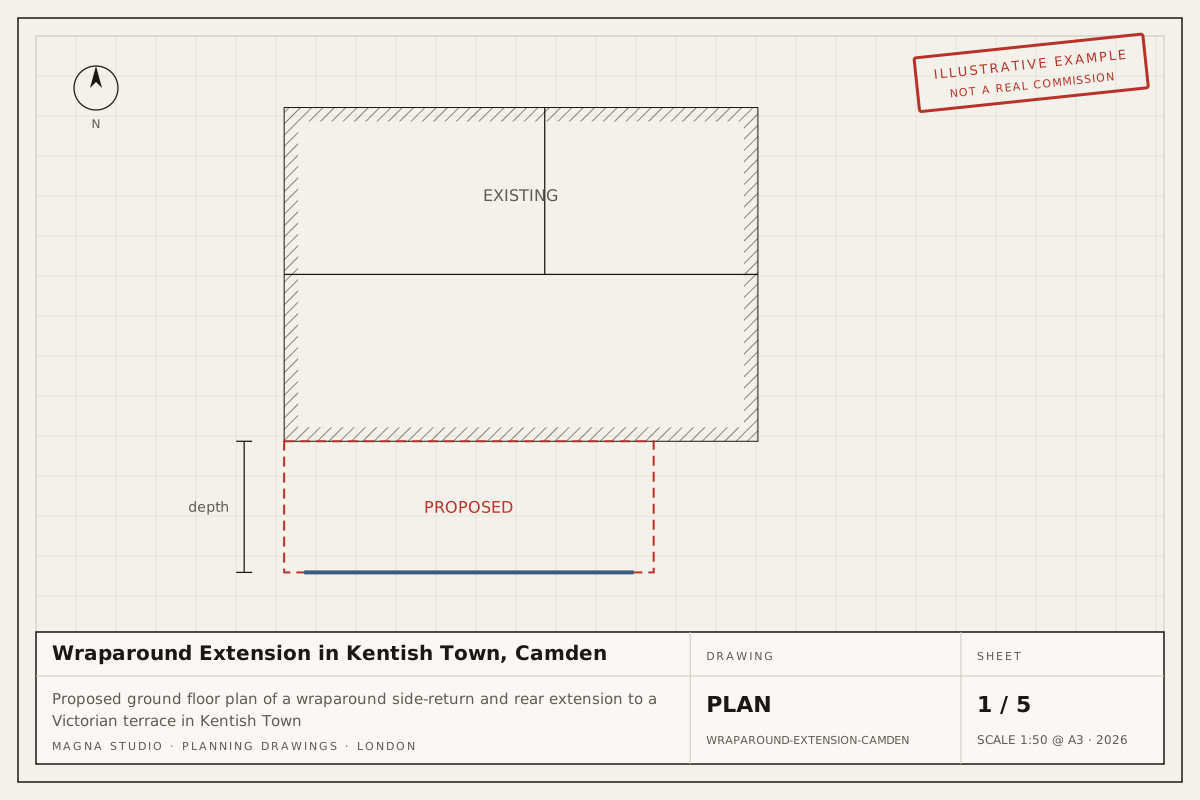
A wraparound combines a side-return infill with a rear extension. Permitted development assesses each part separately, so the side element must stay within half the width of the original house and the rear element within 3 m or 4 m, and the two together must not exceed 50 per cent of the land around the original house.
Because the combined footprint is treated as an extension wrapping the corner, most wraparounds on London terraces fall outside permitted development and need a householder planning application. A Lawful Development Certificate is worth pursuing only where each element clearly meets its own limits.
What changes in Hackney
The side element is not permitted development in a conservation area, so a wraparound there always needs planning permission, designed to the area's appraisal.
The local constraints that most often decide the route in Hackney are listed below, taken from our Hackney area page. Each one is a reason to confirm the address on Hackney's constraints map before relying on permitted development.
- Conservation areas. Hackney has around 30 conservation areas, including De Beauvoir, Clapton Square, Stoke Newington, Clissold Park, Cazenove, Graham Road and Mapledene, and South Shoreditch. Source
- Article 4 directions. Hackney has Article 4 directions in several conservation areas removing permitted development for front alterations, boundary walls and some roof works, and a direction restricting office-to-residential conversions under Class MA in Shoreditch and other employment areas. Source
- Lee Valley flood risk. Hackney Wick, Lea Bridge, Upper and Lower Clapton along the River Lee and the Hackney Marshes edge sit in Flood Zones 2 and 3. Source
- Listed buildings. Clapton Square, Sutton Place, Stoke Newington Church Street and parts of Shoreditch and De Beauvoir contain a high concentration of listed houses. Source
What Hackney planning officers look for
Hackney officers are firm on the character of terrace rear elevations and roofs. Common refusal reasons are rear extensions deeper or taller than the neighbours that fail the 45-degree test, roof extensions in conservation areas that break an unbroken roofline, full-width box dormers, and front dormers. Outside conservation areas, rear dormers within 40 m³ are routinely lawful. Hackney offers a paid pre-application service and we recommend it for anything in a conservation area.
Fees and timelines
Hackney decides a householder application or a Lawful Development Certificate within 8 weeks of validation. The council fee is £528 for a householder application and £264 for a Lawful Development Certificate (England, from 1 April 2025; verify before applying).
Our own fee is fixed once quoted. The quote tool gives an indicative figure in minutes and a written quote follows within 24 hours.
Primary sources
- The Town and Country Planning (General Permitted Development) (England) Order 2015, Schedule 2: the permitted development limits quoted above.
- Planning Portal: do you need permission: the national guidance and the application service every council accepts.
- London Borough of Hackney: planning: the council's own constraints map, validation checklist and pre-application service.